


Rare Disease and CMD on The Hill
Updated: Mar 9

In late February, members of the Cure CMD team and our community braved the snow and rain and embarked on a mission to Washington, DC to take part in Rare Disease Week on Capitol Hill, hosted by The EveryLife Foundation for Rare Diseases.
The week brought together hundreds of advocates from across the United States: patients, caregivers, researchers, and nonprofit leaders, who came together to share their stories with lawmakers and advocate for policies that support rare disease research, diagnosis, and care.
A National Community of Rare Disease Advocates

Although each rare disease affects a small number of people, rare disease itself is anything but rare. In fact, approximately 30 million Americans live with a rare disease; that’s about 1 in 10 people in the United States. Congenital muscular dystrophy (CMD) is one of more than 7,000 rare diseases, and like many rare conditions, families often face long diagnostic journeys, limited treatment options, and significant caregiving demands.
Advocacy events like Rare Disease Week help ensure that lawmakers understand these challenges and work toward solutions.
Cure CMD On The Hill

This year, Cure CMD was proud to be represented by both staff members and community advocates who traveled to Washington to share their experiences and advocate for change.
Representing Cure CMD were:
Lani Knutson, Legislative Advocacy Team Lead and mother of two boys living with SELENON-related CMD, Wisconsin
Avery Roberts, Community Engagement Coordinator and person living with COL6-related CMD, New York
James Immekus, Director of Communications and person living with a rare disease, California
Staff were also joined by members of the CMD community:
Kaitlin and Kurt Chenoweth, along with their daughter Kassidy Chenoweth (11), who lives with COL6-related CMD, Illinois
Jessica Pendleton Parks, mother of a child living with COL6 CMD, Virginia
For Kassidy, the trip was especially meaningful. It was her first time advocating in Washington, DC.
“I wanted to go to Washington, D.C. to help change lives for the better.”
– Kassidy Chenoweth (11), COL6, Illinois [Read more about Kassidy's RDW experience on her blog]
Prepping for Our Meetings
Rare Disease Week began with several days of training and informational sessions organized by the EveryLife Foundation. These sessions helped advocates understand the current policy landscape and prepare them to meet with their members of Congress.

Participants learned about:
How federal legislation becomes law
How rare disease policies affect patients and families
How to share personal stories effectively with lawmakers
What legislative priorities need attention in Congress
Advocates also received practical advice on how to communicate with congressional staff and explain why policies supporting research, diagnosis, and caregiving matter to the communities they represent. For many participants, this preparation helps turn personal experiences into powerful advocacy.
“The moment a congressional staffer connects the rare disease story you shared to an actionable policy they can help with is incredibly powerful.”
– Kaitlin Chenoweth, CMD Mom, Illinois
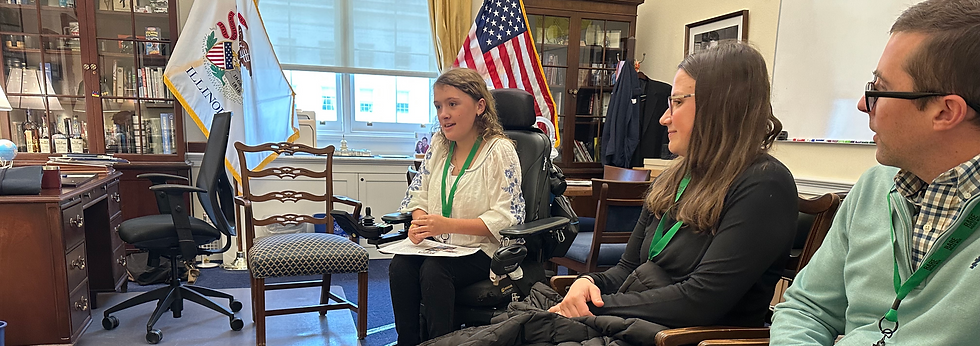
Bringing the CMD Story to Capitol Hill
Kassidy and her guide dog strike a pose at the RDW Advocacy Backdrop Cure CMD Group Photo at RDW Avery Roberts on her way to her Congressional Meeting
Each year, thousands of bills are introduced in Congress, but only a small percentage, often fewer than 5%, become law. With so many issues competing for attention, this underscores the importance for advocates to make their stories memorable. Personal experiences help rare disease issues stand out and stay “sticky” in the minds of lawmakers and their staff, especially when advocates follow up after meetings with a thank-you email or call that reinforces their message.
Personal stories help lawmakers better understand the challenges their constituents face and why policies that support rare disease research, diagnosis, and care matter.
For families living with CMD, these stories are more than statistics or policy talking points. They represent years spent searching for answers, navigating complex medical systems, adapting homes and routines, and fighting for the care their children need to thrive. When shared with lawmakers, these experiences help illuminate the urgent need for research funding, caregiver support, earlier diagnosis, and access to specialized care.

“I wanted to attend Rare Disease Week so I could share my story face to face with senators and representatives.”
– Jessica Pendleton Parks, COL6 Mom, Virginia
Key Policy Priorities
During our meetings on Capitol Hill, the Cure CMD delegation advocated for several important policies supported by the rare disease community.
Joining the Rare Disease Congressional Caucus
One of our primary requests was for lawmakers to join the Rare Disease Congressional Caucus. This bipartisan group of members of Congress works to raise awareness of rare diseases and support legislation that benefits patients and families. Expanding the caucus strengthens the collective voice of the rare disease community in Washington.
Rare Disease Innovation Hub
Advocates also supported funding for a proposed Rare Disease Innovation Hub. This initiative would help coordinate efforts across federal agencies to accelerate rare disease research and improve collaboration between scientists, regulators, and patient organizations. For conditions like CMD, where treatment options are still limited, better coordination could help speed progress toward therapies.
The Genomic Answers for Children's Health Act
This legislative act would expand access to genomic sequencing for children with suspected rare diseases. For many families, the search for a diagnosis can take years. Earlier genetic testing could help families receive answers faster and connect to specialized care sooner. Early diagnosis can also help families participate in clinical research and make informed medical decisions.
The Credit For Caring Act
Across the United States, 1 in 4 adults serves as a caregiver, and many spend thousands of dollars each year supporting loved ones with complex medical needs. The Credit for Caring Act would provide a tax credit to help working family caregivers cover caregiving expenses such as home modifications, assistive technology, transportation, and respite care. For families raising children with CMD, caregiving can require extraordinary time, energy, and financial sacrifice.
Strengthening Rare Disease Treatment Development
Advocates also encouraged lawmakers to support policies that strengthen the rare disease treatment pipeline. One proposal calls for the creation of a Rare Disease and Condition Advisory Committee in the U.S. Food and Drug Administration (FDA). This committee would allow the FDA to consult outside experts when evaluating treatments for rare diseases, helping ensure that regulatory pathways are flexible enough to support innovation while maintaining safety.
Progress Made Through Advocacy
Advocacy from the rare disease community has already led to important policy achievements in the past year.
Recent successes include:
Accelerating Kids’ Access to Care Act
Children with rare and complex medical conditions often need to see highly specialized doctors who may not practice in their home state. However, current Medicaid rules can make it difficult for these children to receive care across state lines, creating delays in diagnosis, treatment, and ongoing medical management.
The Accelerating Kids’ Access to Care Act helps address this challenge by creating a streamlined process that allows certain out-of-state pediatric specialists to enroll as Medicaid providers across multiple states. This reduces administrative barriers that currently prevent children from accessing the expert care they need.
For families living with rare diseases like congenital muscular dystrophy (CMD), access to specialized neuromuscular clinics and expert physicians is critical. This legislation helps ensure that children can receive timely care from the right specialists—no matter where they live.
By making it easier for pediatric specialists to treat Medicaid patients across state lines, the bill improves care coordination, reduces delays in treatment, and helps children with complex medical needs receive the expert care they deserve.
Federal Funding for Medical Research at The National Institutes for Health
In recent years, rare disease advocates have helped secure strong federal investment in medical research through major government funding legislation, including the Consolidated Appropriations Act passed by Congress.
This legislation provides critical funding for the National Institutes of Health (NIH), the largest public funder of biomedical research in the world. NIH funding supports scientists, universities, hospitals, and research institutions working to better understand diseases and develop new treatments.
For the rare disease community, including those living with congenital muscular dystrophy (CMD), this funding is essential. Many discoveries in genetics, neurology, and muscle biology begin with NIH-supported research. These early-stage studies help scientists identify disease mechanisms, explore potential therapies, and lay the groundwork for future clinical trials.
Because rare diseases often affect small patient populations, private investment alone is often not enough to support the early research needed to develop treatments. Federal investment through the NIH helps fill this gap by supporting innovative research that might otherwise never begin.
The inclusion of strong NIH funding in the Consolidated Appropriations Act represents an important step forward for rare disease research, helping ensure that scientists have the resources needed to pursue discoveries that could one day lead to new therapies—and ultimately cures—for conditions like CMD.
Support for Rare Disease Research through Department of Defense Medical Research Programs
While the Department of Defense is primarily associated with national security, these programs fund groundbreaking medical research that benefits both military personnel and civilians. Each year, Congress directs funding toward specific health research areas that have a strong impact on public health.
Through these programs, Congress has supported research into conditions such as muscular dystrophy, ALS, and other neuromuscular and rare diseases. The funding supports scientists working to better understand how these diseases develop and to explore potential therapies.
For rare diseases like congenital muscular dystrophy (CMD), these research programs are especially important. Because rare diseases affect smaller populations, federal funding often plays a critical role in supporting the early scientific work needed to move discoveries toward treatments.
The continued inclusion of these research programs in federal funding legislation helps ensure that scientists can pursue innovative studies, collaborate across institutions, and accelerate progress toward new therapies for people living with rare and neuromuscular diseases.
Ongoing Funding for Muscular Dystrophy Research and Newborn Screening Programs
The Consolidated Appropriations Act maintained federal funding for programs that support muscular dystrophy research and strengthen newborn screening systems across the United States.
Agencies such as the Centers for Disease Control and Prevention (CDC) and the Health Resources and Services Administration (HRSA) use this funding to improve data collection, support research on neuromuscular diseases, and help states operate effective newborn screening programs.
Newborn screening allows babies to be tested shortly after birth for certain genetic and metabolic conditions. Early detection can help families receive answers sooner, connect with specialists, and begin treatment or care planning as early as possible.
For rare diseases like congenital muscular dystrophy, continued investment in these programs helps improve early diagnosis, research, and long-term care for affected families.
These victories show that when patients, families, and advocates speak up together, real progress can happen.

Your Voice Matters
For many rare disease families, advocacy is about more than policy, it is about hope. It means telling your story so future families may face fewer barriers. It means helping policymakers understand what life with a rare disease truly looks like.
“We in the CMD community live with rare disease every day. The individuals you meet with during Rare Disease Week may not have had those same experiences, and they want to hear your story. Without sharing our experiences, change will not happen.”
– Kaitlin Chenoweth, CMD Mom, Illinois
For Kassidy (11, COL6), participating in Rare Disease Week was also a reminder that advocacy has no age limit.
Even though I’m only eleven, I realized my voice can make a difference.
– Kassidy Chenoweth (11), COL6, Illinois
Looking Ahead
Rare Disease Week is just one part of a larger movement to ensure that rare disease communities are heard. Advocacy continues throughout the year, including through initiatives like Rare Across America, (yet to be announced for 2026) which encourages advocates to meet with lawmakers in their home states and districts, in some cases virtually. These conversations help ensure that policymakers continue hearing directly from the communities they represent.
Get Involved
Advocacy is one of the most powerful ways to help advance research and improve care for people living with congenital muscular dystrophy. If you would like to learn more about how to get involved in Cure CMD’s advocacy efforts, we invite you to connect with us.
“We can be the change that rare disease needs.”
- Jessica Pendleton Parks, COL6 Mom, Virginia

Thank you to our CMD community who advocated for rare diseases during this Rare Disease Week and in the past, and for the hundreds of people in our CMD community who have advocated for greater CMD rights and representation. Let's keep the momentum together!
Email: advocacy@curecmd.org
Learn more: curecmd.org/advocacy You can also find your elected representatives here Read More about Kassidy's experience at Rare Disease Week


